

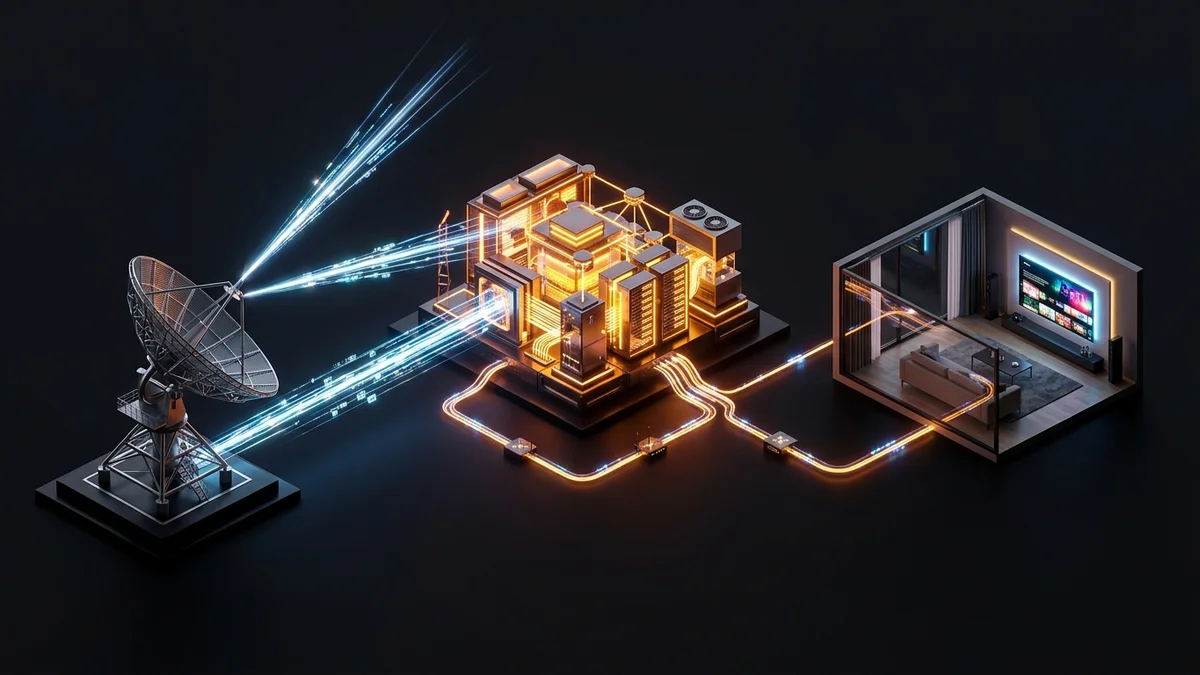
IPTV (Internet Protocol Television) is a digital television transmission standard that delivers live linear broadcast channels, time-shifted catch-up programming, and Video on Demand (VOD) over packet-switched TCP/IP computer networks rather than legacy coaxial radio-frequency (RF) cables or satellite transponders. By leveraging ITU-T Y.1910 IPTV architecture and High Efficiency Video Coding (H.265/HEVC), modern platforms like YEAH live broadcast stream 4K 60fps television directly to Smart TVs, Firesticks, and mobile devices.
Table of Contents
1. What Does IPTV Stand For? (Core Architecture)
With traditional cable or satellite television, broadcasters push every single television channel down the physical wire or transponder simultaneously, and your set-top box tuner physically filters the frequency you select. Internet Protocol Television (IPTV) flips this model completely.
In an IPTV network, video streams remain on distributed edge servers until you click a channel in your Electronic Program Guide (EPG). The moment you select a channel, your player application sends an authenticated HTTP/HTTPS or IGMP request, and the server delivers only the specific compressed video packets you requested. Because bandwidth is not wasted transmitting hundreds of unwatched channels simultaneously, YEAH IPTV can offer tens of thousands of international channels, regional sports feeds, and 4K UHD libraries over a standard home broadband connection.
2. How Does IPTV Work Behind the Scenes?
Every live television broadcast travels through a four-stage engineering pipeline before appearing on your television screen:
- Stage 1: Signal Acquisition & Headend Encoding: Live feeds arrive via fiber, satellite downlinks, or studio HDMI/SDI baseband inputs and are compressed in real time using hardware H.264 (AVC), H.265 (HEVC), or AV1 encoders.
- Stage 2: Transport Stream Packetization & Middleware: The compressed video, multi-track AAC/Dolby audio, and closed captions are multiplexed into MPEG Transport Stream (
MPEG-TS) segments or IETF RFC 8216 HTTP Live Streaming (HLS) chunks, indexed alongside XMLTV program schedules. - Stage 3: Multi-CDN Edge Distribution: Streams are replicated across geographically distributed Content Delivery Network (CDN) edge servers with automated load balancing to prevent congestion during peak live events.
- Stage 4: Client Decoding & Playback: Your device logs in via the Xtream Codes API or M3U playlist protocol, buffers 1.5 to 3 seconds of packets in RAM, and uses its hardware GPU decoder to render smooth 60fps video.
3. The 3 Core Formats of IPTV Services
A complete internet protocol television platform combines three distinct viewing modes inside a single interface:
- Live Linear Television: Real-time broadcasting of news, local networks, and live 50/60fps sports events as they air globally, accompanied by an interactive XMLTV Electronic Program Guide.
- Time-Shifted Catch-Up TV: Cloud-recorded broadcast archives that allow you to scroll backward in your TV guide (typically 3 to 7 days) and replay a live show or match you missed without setting a local DVR timer.
- Video on Demand (VOD): A searchable library of movies, documentaries, and multi-season television series streamed on demand with instant fast-forward, rewind, and subtitle selection.
4. IPTV vs. Cable TV vs. Satellite vs. OTT Streaming
The table below compares how IPTV differs technically and financially from legacy coaxial cable, satellite dishes, and single-studio OTT apps:
| Feature / Metric | Modern IPTV (YEAH IPTV) | Coaxial Cable TV | Satellite TV | Single-Brand OTT |
|---|---|---|---|---|
| Delivery Medium | TCP/IP Broadband (Fiber/Wi-Fi) | Dedicated Coaxial RF Line | Ku-Band Dish Transponder | Public Internet HTTPS |
| Primary Video Codec | H.265 (HEVC) / AV1 / H.264 | Legacy MPEG-2 / H.264 | H.264 / HEVC | H.265 / AV1 / VP9 |
| Channel & VOD Capacity | Unlimited (20,000+ Live & VOD) | Limited by RF Spectrum (200–400) | Limited by Transponders (~500) | VOD Only (Or Limited Live) |
| Hardware Required | Any Smart TV, Firestick, or App | Proprietary Rental Cable Box | Roof Dish + Receiver Box | Smart TV or Streaming Stick |
| Typical Annual Cost | $59/year ($4.92/mo) | $1,080–$1,440/year | $960–$1,320/year | $180–$900/year per app |
5. Equipment & Internet Speed Requirements for 4K IPTV
You do not need expensive proprietary hardware to watch IPTV. Any device capable of running a modern media player app application—such as an Amazon Fire TV Stick 4K Max, Android TV / Google TV box, Samsung Tizen or LG webOS Smart TV, Apple TV 4K, or Windows/Mac computer—can decode streams effortlessly.
- SD / 720p HD Channels: 5 to 8 Mbps sustained download speed.
- 1080p Full HD (60fps Sports): 12 to 18 Mbps sustained download speed.
- 4K Ultra HD (H.265 HEVC 60fps): 25 to 35 Mbps sustained download speed with low network jitter (<15 ms).
Frequently Asked Questions
IPTV (Internet Protocol Television) is a digital television delivery method that transmits live TV channels and on-demand video over packet-switched internet networks (TCP/IP) rather than traditional coaxial cable or satellite radio frequencies.
IPTV delivers live linear broadcast television, interactive Electronic Program Guides (EPG), 7-day Catch-Up TV, and VOD over managed CDN infrastructure or dedicated M3U/Xtream APIs, whereas single-studio OTT apps primarily stream pre-recorded library content.
A stable internet speed of 15 Mbps is sufficient for 1080p Full HD IPTV, while 25 to 35 Mbps with low jitter (<15ms) over 5GHz Wi-Fi or wired Ethernet is recommended for uncompressed 4K Ultra HD 60fps H.265/HEVC streams.
Ready to Experience Buffer-Free 4K & 60fps Streaming?
Activate your YEAH streaming subscription in minutes with Xtream Codes API & M3U credentials, full XMLTV EPG, and 24/7 technical support.
Related Tutorials & Guides
How to Evaluate IPTV Service Providers: 12 Key Benchmarks →
Compare server uptime, H.265 bitrate, and anti-freeze CDN routing before choosing a provider.
XCodes IPTV (Xtream Codes API) vs. M3U Playlists Compared →
Discover why Xtream Codes JSON API loads 30,000+ channels and EPG guides 5x faster than M3U files.